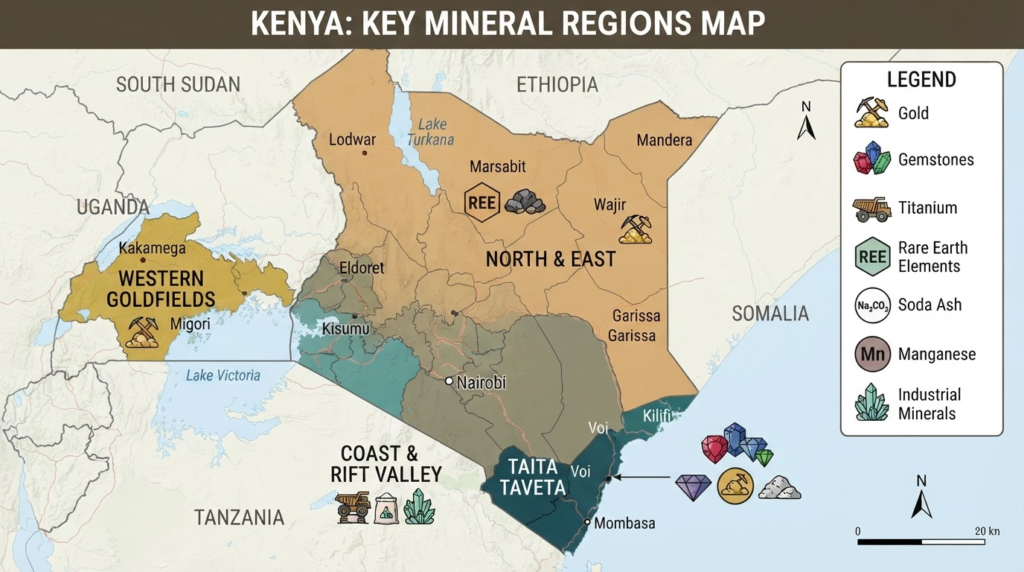
Ask most people what Kenya is known for and mining rarely comes up — safaris and coastline usually win that conversation. Yet Kenya’s geology, shaped over billions of years, holds a genuinely diverse mineral base spread across four distinct zones of the country. For anyone sourcing minerals from Kenya, or simply trying to understand the industry, it helps to know the map.
Western Kenya: The Gold Belt
Kenya’s gold story runs through the west — Migori, Kakamega and the Kilimapesa area near Lolgorian in Narok County. This region hosts both long-running artisanal mining communities and increasingly serious large-scale investment: Shanta Gold’s West Kenya Project, targeting high-grade resources in the Isulu and Bushiangala deposits within the Liranda Corridor, represents a roughly $510 million commitment to the area, while Caracal Gold’s Kilimapesa mine — Kenya’s first licensed gold mine, producing since 2009 — continues expanding.
Western Kenya is also where the government’s push to formalise artisanal gold mining is most visible right now. A new regulatory framework for Kakamega’s artisanal miners includes mandatory licensing, environmental compliance checks, and a planned local gold refinery — a direct response to decades of informal, often dangerous small-scale mining in the region, and an attempt to keep more of that gold’s value inside Kenya rather than losing it across informal cross-border channels.
Taita Taveta: The Industrial and Gemstone Belt
Few regions pack in as much mineral diversity as Taita Taveta. The county sits on deposits of iron ore, manganese, marble, limestone and quartz, alongside a striking range of gemstones — tsavorite, ruby, chrome tourmaline, yellow tourmaline, and both red and green garnets.
It’s also become the site of one of Kenya’s most significant recent mining developments: a Sh11 billion iron ore pelletisation plant at Manga, near Voi, developed by Devki Group, drawing ore from the Kishushe area. The plant is designed to convert raw iron ore into pellets suitable for steel production — processing the mineral locally rather than exporting it raw — and is expected to create thousands of jobs in the region once fully operational. County authorities have described the ambition plainly: turning Taita Taveta into a genuine mining and processing hub, not just an extraction site.
Northern and Eastern Kenya: Copper, Manganese and Chromite
Kenya’s north and east hold deposits of copper, manganese and chromite — a less publicly visible part of the country’s mineral base, but an important one for industrial supply chains that depend on these metals.
The Coast and the Rift Valley: Titanium, Rare Earths and Soda Ash
Along the coast, Kwale County is home to Kenya’s single largest mining operation by value: the Kwale Mineral Sands Project, which has produced titanium minerals — rutile, ilmenite and zircon — since 2013, and remains Kenya’s largest mineral export by value. Nearby Mrima Hill holds significant potential for niobium and rare earth elements, a mineral category attracting growing global interest given demand from electric vehicle battery and technology supply chains.
Further inland, the Great Rift Valley’s volcanic geology has produced its own distinctive mineral wealth — most notably the trona (soda ash) deposits of Lake Magadi, formed through the alkaline volcanism that shaped the Rift over millions of years.
Why This Geography Matters
For a mineral trading company, geography isn’t just trivia — it’s the foundation of what can actually be sourced reliably, and from where. Kenya’s 2023 national geological survey identified 970 distinct mineral occurrences across the country, a figure that reflects just how much of this mineral wealth remains genuinely underexplored. As government policy increasingly pushes for local processing over raw export — visible in projects like the Taita Taveta pelletisation plant and the planned Kakamega refinery — the regions producing these minerals are becoming processing hubs in their own right, not just extraction points.
Understanding where Kenya’s minerals actually come from is the first step to understanding how a responsible mineral supply chain in this country should work.