
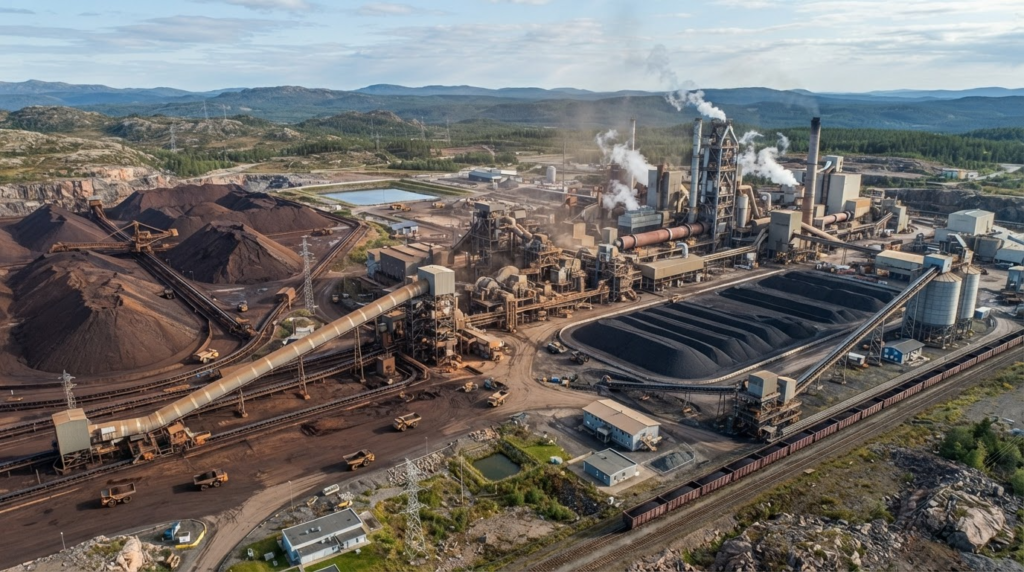
For most of its history, Kenya’s mining sector has followed a familiar pattern seen across much of the African mineral economy: extract the raw mineral, export it, and let the processing — and most of the resulting economic value — happen somewhere else. That pattern is now being deliberately dismantled, and the shift is worth understanding if you’re doing business in Kenyan minerals.
The Message From the Top
Opening the 2026 Mining Investment Conference in Nairobi, President William Ruto made the government’s position unambiguous: minerals extracted in Kenya should be processed and refined in Kenya, not shipped out raw for someone else to add the value. He framed it as a continental issue, not just a national one — arguing that the full mineral value chain needs to generate value for Africa, not just for the markets that eventually receive the finished product.
This isn’t just rhetoric. It’s backed by a specific, stated target: the Kenyan government wants to raise mining’s contribution to GDP from under 1% today to 10% by 2030 — a target that is simply not achievable through raw extraction and export alone. Reaching it requires processing, refining and manufacturing to actually happen inside the country.
What This Looks Like on the Ground
Two live projects illustrate exactly what this policy shift means in practice.
In Taita Taveta, Devki Group’s Sh11 billion iron ore pelletisation plant at Manga, near Voi, has already flagged off its first shipment of ore from the Kishushe mining area. Pelletisation converts raw iron ore into pellets suitable for steel production — meaning the ore doesn’t leave the country in its raw state, it leaves (or gets used domestically) as a processed, higher-value input. County officials view the project as the foundation for turning Taita Taveta into a genuine mining and processing hub, with the backward and forward economic linkages — local suppliers, service providers, jobs — that come with that.
In Kakamega, a similar logic is being applied to gold. Rather than continuing to lose value through informal cross-border gold trading, the government has unveiled a formalisation framework for the region’s artisanal gold miners that includes the construction of a local gold refinery — meaning gold extracted in western Kenya gets processed and its value captured within Kenya, rather than leaving the country as raw, unrefined material.
Why This Matters for a Mining and Trading Company
For a company that manages the full mineral value chain — exploration through to trading and export — this shift isn’t a threat, it’s a validation of the model. Companies set up to only extract and export raw ore are increasingly out of step with where Kenyan mining policy is heading. Companies capable of processing minerals to specification before they reach a buyer are positioned exactly where the industry is moving.
It also changes what buyers should expect and ask for. A processed, graded, specification-matched mineral product represents more consistent quality and more traceable sourcing than raw ore handed off between multiple unrelated parties at each stage. As Kenya’s own regulatory and investment climate increasingly rewards local processing, buyers sourcing from companies built around that model are aligning with where the market — and the law — is heading.
Our Position
Manidweepa Minerals Kenya Limited’s operating model — exploration, mining, processing and trading all managed directly — reflects exactly this shift in Kenyan mining policy. Processing to specification before export isn’t a value-add we’re building toward; it’s the foundation the company already operates on.