
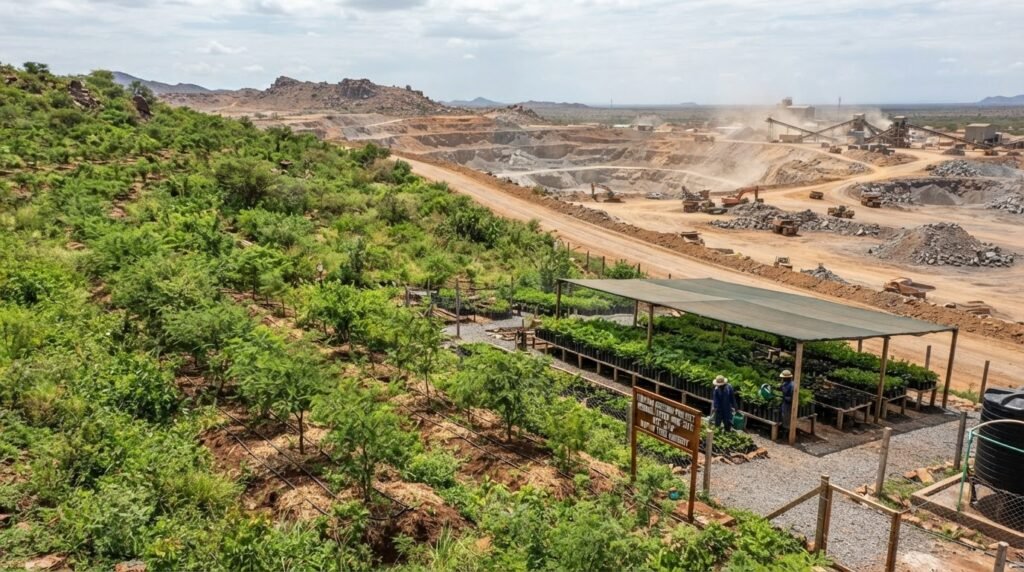
A mine’s relationship with the community around it doesn’t end when extraction does — if anything, that’s when the most important questions get asked. What happens to the land once the ore is gone? Did the community that hosted a mining operation for years actually benefit from it, or just live alongside it? In Kenya, these aren’t abstract questions. They’re written into law.
The Legal Foundation: Community Development Agreements
Since the Mining Act, 2016, any company holding a large-scale mining licence in Kenya is legally required to sign a Community Development Agreement with the community hosting its operations — a binding commitment, funded through a share of the company’s gross revenue, to deliver real development outcomes in that community. It’s not framed as charity. It’s framed as a condition of the licence itself.
What this looks like in practice varies by community, but the pattern is consistent: infrastructure, education and healthcare investment, direct employment preference for local residents, and formal training programmes designed to build skills that outlast the mine itself. Base Titanium’s work in Kwale County is one of the more visible examples of this in action — funding an early childhood development centre, secondary school dormitories, and longer-running agricultural livelihood and health programmes through its Community Development Agreement Committees, alongside a deliberate focus on exposing local youth to the technical skills needed for employment in the sector.
Rehabilitation: Giving the Land Back
The other half of responsible mining is what happens after extraction — and it’s an area where Kenya’s regulatory framework is actively catching up to global best practice. Proposed 2026 regulations introduce, for the first time, a formal mine rehabilitation licence, making land restoration a legally accountable part of the mining process rather than a voluntary gesture left to a company’s discretion.
Again, Base Titanium’s Kwale operation offers a concrete picture of what this can look like when done seriously: exposed mining pits transformed back into vegetated land through active reforestation, with one of the largest indigenous tree nurseries in East and Central Africa established specifically to propagate native species — including several considered significant enough for international conservation watch lists. Independent monitoring around the site has recorded well over a hundred bird species and a growing range of butterfly, amphibian and reptile life returning to rehabilitated land. None of that happens by accident; it happens because rehabilitation was planned as deliberately as the extraction itself.
Why This Matters Beyond Compliance
It would be easy to treat all of this as a regulatory checklist — sign the agreement, fund the projects, restore the land, move on. But the underlying logic is simpler and more important than that: a mining company operates in a specific place, alongside specific people, for a finite period of time. What it leaves behind — economically, socially and environmentally — is the actual measure of whether that operation was responsible, regardless of how efficiently the mineral itself was extracted.
Kenya’s push toward mandatory Community Development Agreements and, soon, mandatory rehabilitation licensing reflects a hard-won lesson from mining sectors around the world: without a legal requirement to reinvest in the communities and land involved, that reinvestment often doesn’t happen at the scale it should.
Our Commitment
At Manidweepa Minerals Kenya Limited, community development and environmental responsibility sit alongside safety and quality as core operating values not as a separate CSR programme bolted onto the business, but as part of how we plan every operation within Kenya’s Mining Act, 2016 framework, from the community agreements we enter into to the land we’re ultimately responsible for restoring.
Responsible mining doesn’t end when the ore stops coming out of the ground. In Kenya today, increasingly, neither does the law.