
Most people encounter minerals only at the end of a very long journey — as steel in a building, glass in a window, or gold in a piece of jewellery. Getting there involves a chain of highly technical, tightly regulated stages, each demanding a different kind of expertise. At Manidweepa Minerals Kenya Limited, we manage that entire chain ourselves, rather than handing pieces of it off to unrelated contractors. Here’s what that actually looks like, stage by stage.
Stage 1: Mineral Exploration
Every mineral operation starts long before any ore comes out of the ground. Exploration is the process of proving that a deposit is real, sizeable, and worth developing — geological surveys, prospecting, sampling and resource evaluation, often carried out over months or years before a single tonne is extracted.
Kenya’s own geology makes this a genuinely rewarding place to explore. A nationwide geological survey completed in 2023 identified 970 distinct mineral occurrences across the country, spanning precious metals, gemstones, industrial minerals and rare earth elements — far more than most outsiders assume for a country better known internationally for its wildlife and coastline than its geology. That scale of untapped potential is a big part of why the exploration stage matters so much: get it right, and you’ve found a resource worth decades of responsible development.
Stage 2: Mining Operations
Once a deposit is confirmed, extraction begins — and this is where modern technology and safety culture matter most. Kenya’s mining sector is currently undergoing a significant regulatory upgrade specifically focused on this stage: the Ministry of Mining, Blue Economy and Maritime Affairs has been running nationwide public participation on a new set of Mine Health, Safety and Environment Regulations, designed to replace outdated rules and modernise safety standards across large-scale, small-scale and artisanal operations alike. The reforms include, for the first time, a formal mine rehabilitation licence — meaning restoring a site after mining is no longer an afterthought, but a legal requirement built into the process from the start.
We built our own extraction practices around this same philosophy well before it became a formal requirement: modern equipment, disciplined safety protocols, and environmental impact kept front of mind at every stage — not bolted on at the end.
Stage 3: Mineral Processing
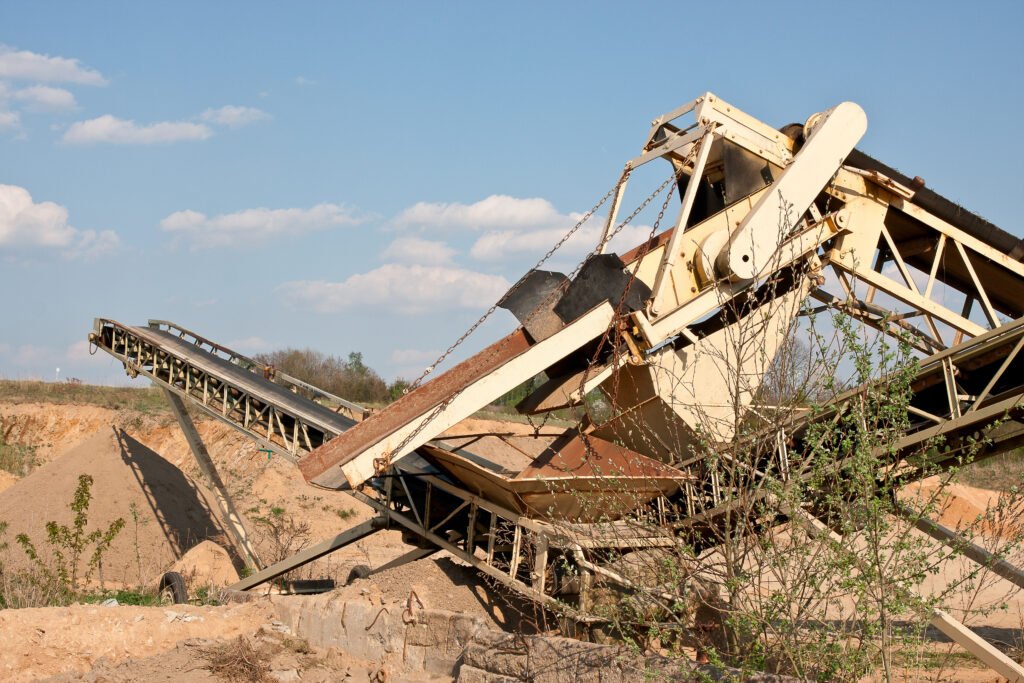
Raw ore is rarely useful in the form it comes out of the ground. Crushing, screening and grading turn it into a product that actually meets a buyer’s specification — the right particle size, the right purity, the right consistency, shipment after shipment.
This stage is also where Kenya’s mining sector is going through one of its most important shifts. For decades, Kenyan minerals have largely been extracted and exported raw, with the processing and value-addition happening elsewhere. That’s now changing. At the 2026 Mining Investment Conference in Nairobi, the government made local processing a central theme — pointing to projects like the new iron ore pelletisation plant in Taita Taveta as proof that minerals can be processed within Kenya rather than shipped out as raw ore. A gold refinery planned for Kakamega, aimed at processing artisanal gold locally rather than losing that value across the border, follows the same logic.
Processing done properly, close to the source, keeps more of a mineral’s value inside the country and inside the communities where it was extracted — a principle we build into how we think about our own operations.
Stage 4: Trading & Export
The final stage is getting a finished, specification-matched product reliably into the hands of the buyers who need it — domestic industry or international markets — on schedule and at consistent quality. This is where geology, engineering and regulatory compliance all have to come together into something as simple as a shipment arriving on time.
Why the Full Chain Matters
Companies that only handle one link in this chain — say, extraction without processing, or trading without any direct mining operations — are ultimately dependent on other parties for quality and timing they don’t control. Managing exploration through to export ourselves means we can guarantee consistency at every stage, respond directly to a buyer’s specification, and take direct responsibility for how a mineral is sourced — not just where it ends up.
That’s the model Manidweepa Minerals Kenya Limited is built on, and it’s the same model Kenya’s mining sector as a whole is increasingly being pushed toward, as the country works to capture more value from its own mineral wealth rather than exporting it raw.