
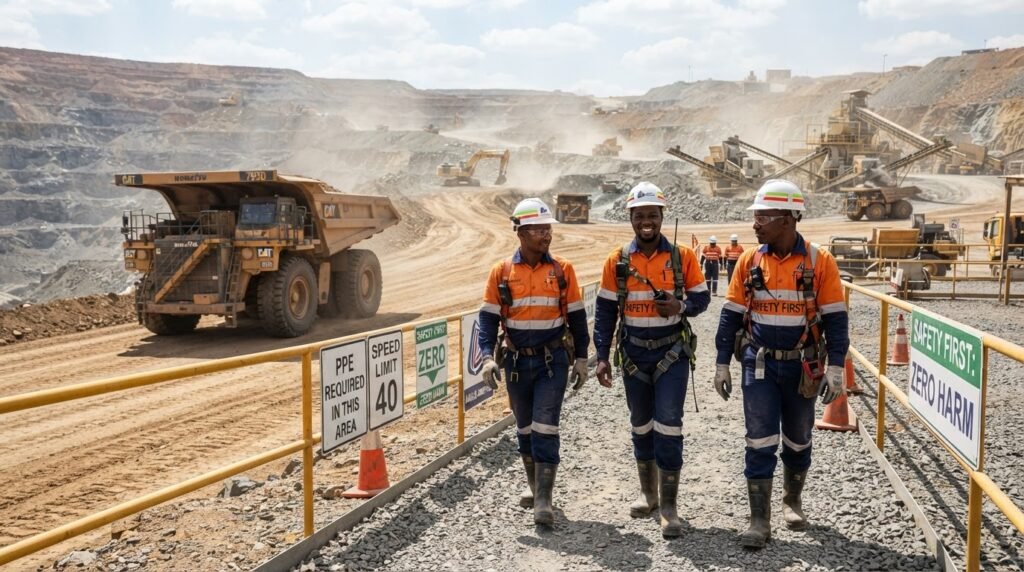
Safety in mining is rarely a topic that makes headlines until something goes wrong. In Kenya, that’s beginning to change — not because of a single incident, but because the government is proactively rewriting the rules that govern mine safety across the entire sector, from the largest industrial operations down to individual artisanal miners.
Why the Rules Are Being Rewritten
Kenya’s Ministry of Mining, Blue Economy and Maritime Affairs has run a nationwide public participation process on a package of proposed legislation, including the Mine Health, Safety and Environment Regulations, 2026, designed to replace outdated rules that no longer reflect how the sector actually operates today. Speaking at a public forum in Mombasa, the Ministry’s Director of Licensing, Compliance and Enforcement described the goal plainly: strengthening the safety of workers and operators across large-scale mines, small-scale mines and artisanal miners alike, with the explicit aim of reducing accidents and improving compliance.
The proposed regulations introduce something Kenya’s mining law hasn’t had before: a formal mine rehabilitation licence, making the restoration of a mining site — not just its extraction — a licensed, legally accountable part of the mining process. Alongside this sits a Draft Explosives Bill, 2026, tightening how explosives are handled and regulated across the industry.
The Scale of the Problem This Is Meant to Solve
The urgency behind these reforms becomes clearer when you look at the informal side of Kenya’s mining sector. More than 250,000 people work in artisanal and small-scale gold mining in Kenya, according to industry estimates — a number that keeps growing as more people, particularly in western Kenya, turn to mining as a primary source of income. Much of this work happens with limited access to modern safety equipment, and — in gold processing specifically — with continued reliance on mercury, a toxic substance with serious health consequences for miners and surrounding communities alike.
Separately, at this year’s Kenya Mining Investment Conference & Expo, the Mining Cabinet Secretary raised a related concern: some sites originally licensed as small artisanal operations have quietly evolved into near-industrial-scale mining, operating with the safety standards of the former while working at the scale of the latter — a mismatch that leaves both workers and surrounding land genuinely at risk when rehabilitation and safety obligations aren’t enforced at the scale actually being mined.
What Responsible Mining Looks Like in Practice
Kenya already has real examples of what safety-first, rehabilitation-conscious mining looks like at scale. Base Titanium’s operation in Kwale County — the country’s largest mining project — has built its entire operating culture around the principle that a safe, healthy working environment comes first, and has paired that with active land rehabilitation: transforming worked-out mining pits back into vegetated, biodiverse land, including one of the largest indigenous tree nurseries in East and Central Africa, used to propagate species significant enough that some appear on international conservation watch lists.
That kind of standard — safety and rehabilitation treated as core to the operation, not an afterthought once extraction is complete — is exactly the direction Kenya’s new regulatory framework is pushing the entire sector toward.
Our Approach
At Manidweepa Minerals Kenya Limited, we don’t treat the arrival of stricter regulation as something to react to — we build our operations around the same principles the new rules are formalising: strict health and safety standards for our employees, contractors and surrounding communities, and environmental management practices designed around responsible extraction and eventual rehabilitation, not just output.
As Kenya’s mine safety framework modernises, the companies already operating to that standard won’t need to change how they work. They’ll simply be operating exactly as the law now requires everyone to.